Skip to content

Architecture
That Fits
Its Purpose

No more. No less. Exactly right.

The dominant failure in Enterprise Architecture is not incompetence — it is misalignment. The Fit-for-Purpose concept is a practitioner framework built on 20+ years of field experience to configure every architectural engagement precisely to its context, delivering maximum decision value at minimum effort.

BUY ON AMAZON

Paperback and Kindle edition available now

THE CORE PROBLEM

Three Phrases Every Business Leader recognizes

"We got a great model. By the time it was done, we had already decided."

Missing the Business Cycle

"The architecture was technically perfect. Nobody used it."

The Ivory Tower

"We paid for six months of analysis. We still don't know what to build."

Boiling the Ocean
THE FOUNDATION

Three Pillars of Fit-for-Purpose Architecture

The Fit-for-Purpose concept rests on three governing propositions — each addressing a distinct dimension of architectural failure.

PILLAR 01

Concern-Driven

ARCHITECTURE EXISTS TO RESOLVE CONCERNS

Architecture exists to resolve specific stakeholder concerns, not to produce comprehensive documentation as an end in itself. Every architectural effort must be traceable to a concrete business question that requires answering or a decision that requires enabling.

Diagnostic question: What specific business decisions are currently blocked?

PILLAR 02

Right-Sized Granularity

JUST ENOUGH, JUST IN TIME

The appropriate level of architectural detail is the minimum required to enable correct implementation without ambiguity — and that level is determined by context, not by convention. There is no universally correct level of granularity.

Diagnostic question: What is the minimum detail that removes implementation ambiguity?

PILLAR 03

Value-to-Effort Ratio

EVERY ENGAGEMENT IS AN INVESTMENT

The business value of the architectural information produced must always exceed the cost — in time and resources — invested in creating it. Architecture that costs more to produce than the value it enables is not merely inefficient; it is counterproductive.

Diagnostic question: Is the cost proportionate to the value of the decision being enabled?

THE CONCEPTUAL EQUATION

The Optimization Objective

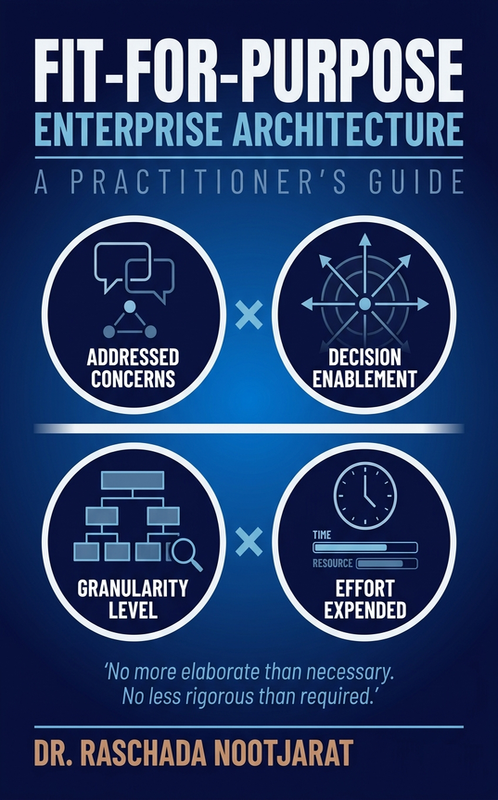
The Fit-for-Purpose Conceptual Equation is a model that makes explicit what every architectural engagement is trying to achieve. Not simply a mathematical formula.

Fit for Purpose =

Addressed Concerns × Decision Enablement


Granularity Level × Effort Expended

SAMPLE A - LOW SCORE (OVER-ENGINEERED)

12 weeks. Comprehensive model Filed and never used.

A business unit needed a funding decision in 6 weeks about 5 capability areas. The team delivered a complete 37-capability model 2 weeks after the budget cycle closed. Three stakeholders attended the readout. High cost, zero value.

SAMPLE B - HIGHSCORE (FIT-FOR-PURPOSE)

1 week of focus. Three targeted briefs. Decision made in week 4.

The architect identified the three specific concerns blocking the investment decision and produced a targeted heat map covering those areas only, with a one-page decision brief for each. Low cost, high value. The investment decision was made on time, fully informed.

THE ENGAGEMENT FRAMEWORK

Six Engagement Archetypes

Enterprise Architecture engagements, despite their enormous variety, cluster around six recognizable patterns. Understanding which archetype applies is the foundational step in configuring every engagement correctly.

Supporting Strategy

Architecture contributes to strategic planning by assessing feasibility, surfacing constraints, and providing a coherent framework for evaluating strategic options at a broad level.

Critical Success Factor: Early engagement — the earlier you engage, the more risk you mitigate.

Landscape Portfolio

Systematic assessment of the existing application and capability landscape to identify redundancies, gaps, and rationalization opportunities across multiple domains.

Critical Success Factor: Focus on value alignment — secure executive mandate before beginning analysis.

Project Portfolio

Architectural guidance to manage dependencies, sequence delivery, and ensure a portfolio of active projects moves coherently toward the Target Architecture.

Critical Success Factor: Optimize funding — dependency-before-sequencing as the governing discipline.

Foundational Change

Architecture provides a common framework for significant structural change — mergers, operating model redesigns — transforming ambiguity into shared vision through structured facilitation.

Critical Success Factor: Transform ambiguity into shared vision before detailing the target.

Bounded Change

Target-led architecture development for a defined change initiative. The Target Architecture is defined first and maintained as the stable anchor throughout concurrent delivery.

Critical Success Factor: Target-first approach — prevents perpetuation of sub-optimal legacy systems.

Implementation Governance

Ensuring implementations are delivered in alignment with the approved Target Architecture through compliance assessment, dispensation management, and architecture as a service.

Critical Success Factor: Benefits realization — clarity and accessibility of the architecture under governance.

THE DIAGNOSTIC FRAMEWORK

18 Failure Patterns. Specific Remedies.

The Fit-for-Purpose concept is the only EA practitioner framework with a structured diagnostic taxonomy of 18 named failure patterns — organized by their primary tailoring axis root cause — with specific remedies expressible in configuration terms.

Most architectural frameworks tell practitioners what to do when things go right. The FfP Diagnostic is built for when they go wrong — identifying the failure early enough to correct it before the second half of the engagement is planned.

Applied at engagement initiation, midpoint, and closure, the 18-pattern checklist (Appendix E of the book) converts retrospective analysis into active risk management.

AXIS 1 FAILURES

Architecture Engagement

AXIS 2 FAILURES

Architecture Capability

AXIS 3 FAILURES

Architecture Content

error: Content is protected !!