Stop Asking. Start Listening. How Event-Driven Architecture and CQRS Unlock Real-Time Customer Intelligence.
Two patterns. Two different problems. One architectural decision that makes them work as a system — and why neither is sufficient without the other.
Series: The Living Data — Part 2 of 3
"Event-Driven Architecture solves the latency problem. CQRS solves the performance problem. Together, they create the architectural foundation for real-time customer intelligence. This article examines why each pattern was chosen, how they work together, and what the reasoning reveals about how strategic architecture actually thinks."
In Part 1 of this series, we diagnosed the data silo problem as a structural constraint — not a storage challenge, but a flow challenge. The organization had the data. It could not move it to where it was needed, when it was needed, without degrading the systems that produced it.
Two patterns resolved that challenge. They were not chosen because they were technically fashionable or architecturally impressive. They were chosen because they were the most direct response to two specific, named concerns. Understanding why requires understanding what each concern actually was.
PATTERN ONE: EVENT-DRIVEN ARCHITECTURE – From Asking to Listening
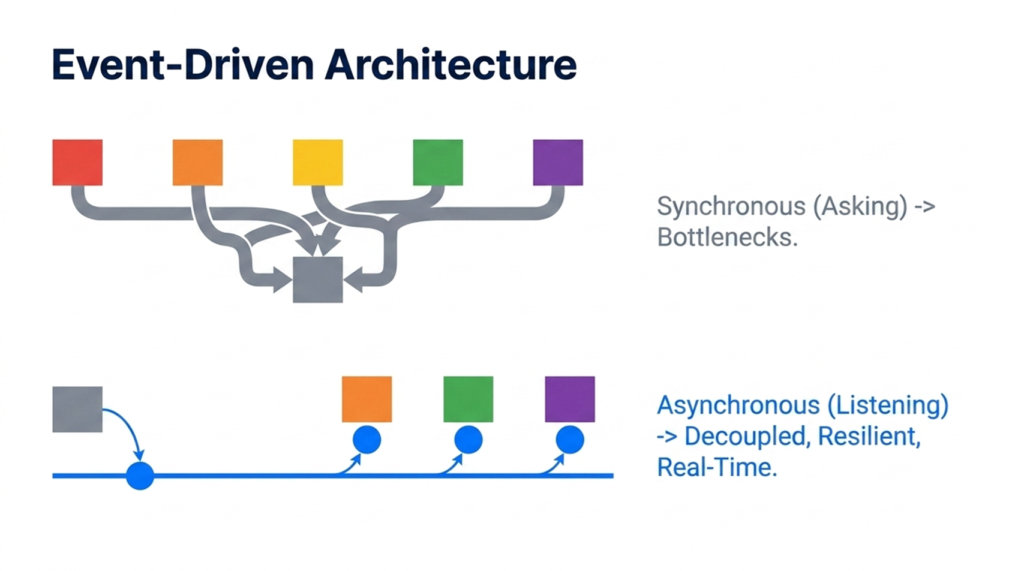
WHAT IS EVENT-DRIVEN ARCHITECTURE?
In a traditional integrated system, services communicate through direct requests — one system asks another for information and waits for the response. This is synchronous: the asking system is dependent on the responding system's availability and speed.
Event-Driven Architecture (EDA) replaces direct requests with events. When something significant happens — a purchase is completed, a customer status changes, a payment fails — the system that observed that event publishes a notification: "this happened." Any other system that needs to respond to that event subscribes to the notification and acts on it independently, at its own pace, without the originating system needing to know or care who is listening.
The result is a loosely coupled architecture: systems are aware of events but not dependent on each other's availability. A slow or unavailable system does not delay the others. New capabilities can be added by subscribing to existing events without modifying the systems that produce them.
EDA is most valuable when: multiple downstream systems need to react to the same upstream events, real-time responsiveness is a business requirement, or the organization needs to add new capabilities without modifying existing systems.
THE CONCERN IT RESOLVED
In the legacy architecture, every system that needed customer data had to ask for it directly — querying the core ERP each time a front-line employee opened a customer record, each time a loyalty system needed to check a balance, each time a marketing system needed to verify a status. The ERP, already carrying significant computational load from financial transactions and batch processing, was being asked to also serve as a real-time data provider for an increasing number of downstream consumers.
The consequence was predictable. Response times degraded. Query queues built up. In peak periods — campaign launches, end-of-month processing — the system could not reliably serve both its primary function and the growing number of systems requesting data from it.The architectural concern was precise: how do we get real-time customer data to the systems that need it, without placing additional load on the system of record that produces it?
THE REASONING BEHIND THE CHOICE
Event-Driven Architecture resolved this by inverting the communication model. Rather than downstream systems asking the ERP for data, the ERP publishes events when significant things happen — and the downstream systems listen.
When a customer completes a purchase, the ERP publishes an event: a purchase was completed. The loyalty system, the inventory system, the marketing platform, and the customer dashboard each subscribe to that event and update their own records independently. The ERP does not wait for any of them. It does not know they exist. It simply announces what happened and continues.
Three strategic properties made this the right choice for this specific problem.
Decoupling. The ERP no longer has any dependency on the systems that consume its events. New capabilities — an AI recommendation engine, a predictive churn model, a real-time campaign trigger — can be added by subscribing to existing events without a single line of code changing in the ERP. The system of record remains stable. The innovation layer grows independently around it.
Resilience. If a consuming system is temporarily unavailable, the events it missed are held in the event bus — the central distribution hub through which events flow — and delivered when the system returns online. No data is lost. No event is permanently missed. The architecture tolerates component failures without cascading them.
Real-time responsiveness. Events move from origin to consumer in milliseconds rather than hours. The front-line employee opening a customer record sees the purchase that happened two minutes ago, not the one from yesterday's batch cycle. The loyalty balance reflects the transaction that just completed. The customer experience the organization can now deliver is categorically different from what the polling architecture made possible.
CO-CREATION: DEFINING THE EVENTS THAT MATTER
One of the most important steps in implementing an event-driven architecture is also one of the most frequently skipped: defining, with the business, which events are worth publishing.
Not every database change is a business event. Not every transaction is a signal that downstream systems need to act on. The events that the architecture publishes should reflect moments that have genuine business meaning — a customer reaching a new loyalty tier, a payment failing, a high-value order being placed.
This definition cannot be done by the architecture team alone. It requires a structured conversation with the business stakeholders who understand which moments actually change what a front-line employee should do, what a marketing system should trigger, or what a risk model should flag.
The validation question that guided this engagement was direct: if this event reached your screen within two seconds, would it change how you handle this interaction? If the answer was yes, the event belonged in the architecture. If the answer was no, the event was noise — and publishing noise is just a faster way to create a different kind of silo.
PATTERN TWO: COMMAND QUERY RESPONSIBILITY SEGREGATION – Separating the Act of Writing from the Act of Reading
WHAT IS CQRS?
Command Query Responsibility Segregation (CQRS) is an architectural pattern that separates the operations that change data — commands — from the operations that read data — queries — into two distinct models, each optimized for its specific purpose.In a traditional architecture, a single data model serves both purposes: the same database that accepts a new order also serves the dashboard that displays customer history. This creates a structural tension: the consistency requirements of write operations and the speed requirements of read operations pull the data model in opposite directions.
CQRS resolves this by maintaining two separate models. The write model — the command side — is optimized for consistency and correctness. Every transaction is validated, business rules are applied, and the system of record is updated accurately. The read model — the query side — is optimized for speed and presentation. Data is pre-formatted for display, stored in a structure that requires no complex joins or transformations at query time.
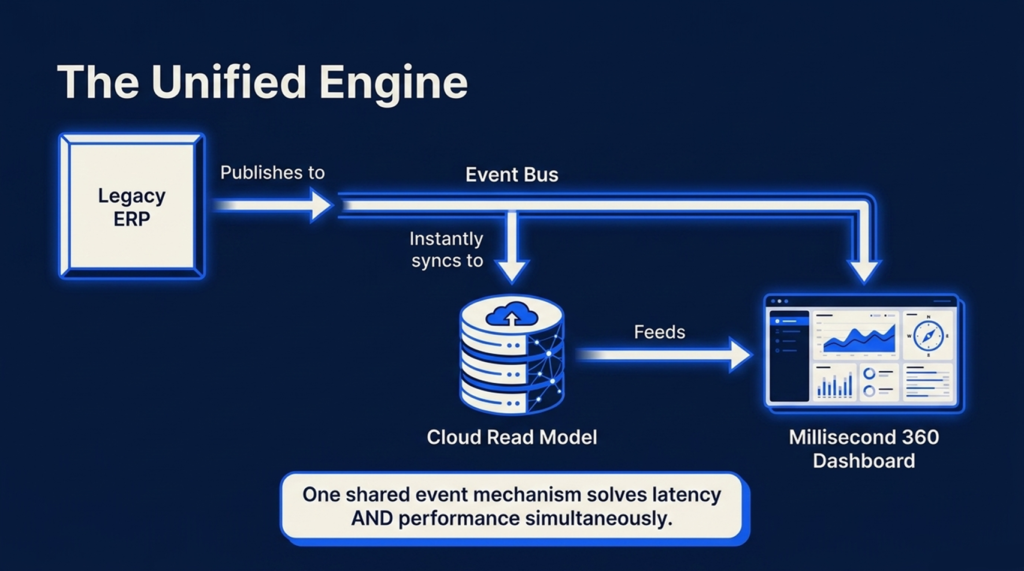
The two models stay synchronized through the same event mechanism that EDA uses: when a write operation completes, it publishes an event, and the read model updates accordingly.
CQRS is most valuable when: read and write volumes are significantly different, the data model for display differs substantially from the data model for storage, or performance under peak load is a business-critical requirement.
THE CONCERN IT RESOLVED
The event-driven architecture resolved the latency problem — data now moved in real time from the ERP to the systems that needed it. But a second, distinct concern remained.
The Customer 360 dashboard — the screen that gives front-line employees a complete view of the customer — had to serve thousands of simultaneous users, each pulling a complex view of data from multiple sources, in real time, at millisecond response speeds. During major campaigns, that load could increase by an order of magnitude within minutes.
If the dashboard queried the same data model that the ERP used for financial transactions, two problems would emerge. First, the query load would compete with the write load — the same system processing a surge of promotional purchases would also be serving a surge of dashboard queries. Second, the data model optimized for transactional accuracy — deeply normalized, with complex relationships — is not optimized for display. Producing the customer view the dashboard needed required joining multiple tables and applying multiple transformations at query time, adding latency with every request.
The architectural concern was equally precise: how do we serve a high-volume, low-latency read workload without degrading the transactional write workload — and without rebuilding the system of record?
THE REASONING BEHIND THE CHOICE
CQRS resolved this by acknowledging a truth that is obvious once stated but rarely designed for: reading and writing data are fundamentally different activities, with fundamentally different requirements.
The write side — the ERP as system of record — was left unchanged. It continued to manage transactions with the consistency and accuracy that financial operations require. Its data model remained optimized for correctness.
A separate read model was built on the cloud platform, designed specifically for the display requirements of the Customer 360 dashboard. The data in this model was stored in a pre-formatted, pre-aggregated structure — the customer record as the dashboard needed to see it, ready to be returned immediately without joins or transformations. When the ERP completed a transaction and published an event, a small synchronization service subscribed to that event and updated the read model accordingly.
The result was a dashboard that responded in milliseconds under any load, served from a model that could be scaled elastically on the cloud platform without touching the ERP, at a fraction of the cost of scaling the transaction system itself.
HOW THE TWO PATTERNS WORK AS A SYSTEM
EDA and CQRS are not independent choices that happened to be applied to the same problem. They are complementary halves of a single architectural decision.
EDA solves the movement problem: how does data get from the system of record to the systems that need it, in real time, without coupling those systems together? The answer is events — the ERP publishes what happened, and every interested system responds independently.
CQRS solves the performance problem: how does the system that displays data serve high-volume, low-latency read requests without competing with the write workload? The answer is separation — maintain a read model optimized purely for display, synchronized from the write model through the same events that EDA produces.
The event that EDA uses to propagate a transaction from the ERP is the same event that CQRS uses to update the read model. The two patterns share a mechanism. The synchronization service that keeps the read model current is simply another subscriber to the event bus that the EDA architecture already established.
Neither pattern is sufficient alone. EDA without CQRS produces real-time data that still hits the transactional system at query time. CQRS without EDA produces a read model that either depends on batch synchronization or requires tight coupling to the write model. Together, they produce an architecture that is real-time, decoupled, independently scalable, and resilient to the failure of any individual component.
THE FIT-FOR-PURPOSE EVALUATION
Both patterns were evaluated against the same three questions that govern every architectural decision in a Fit-for-Purpose engagement.
Which specific concern does this address? For EDA: the inability to get real-time customer data to downstream systems without degrading the ERP. For CQRS: the inability to serve high-volume read requests without competing with transactional write workload.
Is this the minimum change that resolves the concern? Both patterns were assessed against simpler alternatives — polling architectures, consolidated database approaches, read replicas. Each alternative was found to resolve one concern while creating another. The combination of EDA and CQRS was the minimum that resolved both concerns simultaneously without introducing new dependencies.
Is the investment proportionate to the value? The business case was evaluated against the revenue impact of real-time up-sell and cross-sell opportunities at the point of service, the cost reduction from eliminating manual data reconciliation, and the competitive value of a customer experience that no legacy architecture could support. The investment was justified on each dimension.
The patterns were chosen because they were right for this problem. That is the only reason patterns should ever be chosen.
Next in this series — Part 3: Building the Bridge Without Breaking the Bank. How data crosses the boundary between legacy and modern systems without corrupting either — and why the people inside the architecture ultimately determine whether it delivers value.