Your Customer Data Is Everywhere. That Is the Problem.
Data silos are not a storage problem. They are a strategic constraint — and the organizations solving them are not thinking about databases. They are thinking about flow.
Series: The Living Data — Part 1 of 3
"Most organizations have more customer data than they know what to do with. The problem is not the volume. It is that the data is fragmented across systems that were never designed to talk to each other — and every day that continues, business decisions are made on an incomplete picture. Here is what it costs, and what a different approach looks like."
There is a moment most customer-facing teams recognize. A customer calls in, and the person on the other end of the line can see the account. They can see the open order. What they cannot see is the complaint from last week, the loyalty points balance, the web browsing session from this morning that strongly suggests what the customer is about to ask for.
That information exists. It is sitting in three different systems, each of which was built to do its job well — and none of which was designed to share what it knows with the others in real time.
This is the data silo problem. And at the scale of a large enterprise, it is not a minor inconvenience. It is a structural constraint on the organization's ability to serve its customers, respond to market signals, and compete on the intelligence it already possesses.
THE SILO CRISIS: THREE FAILURE MODES
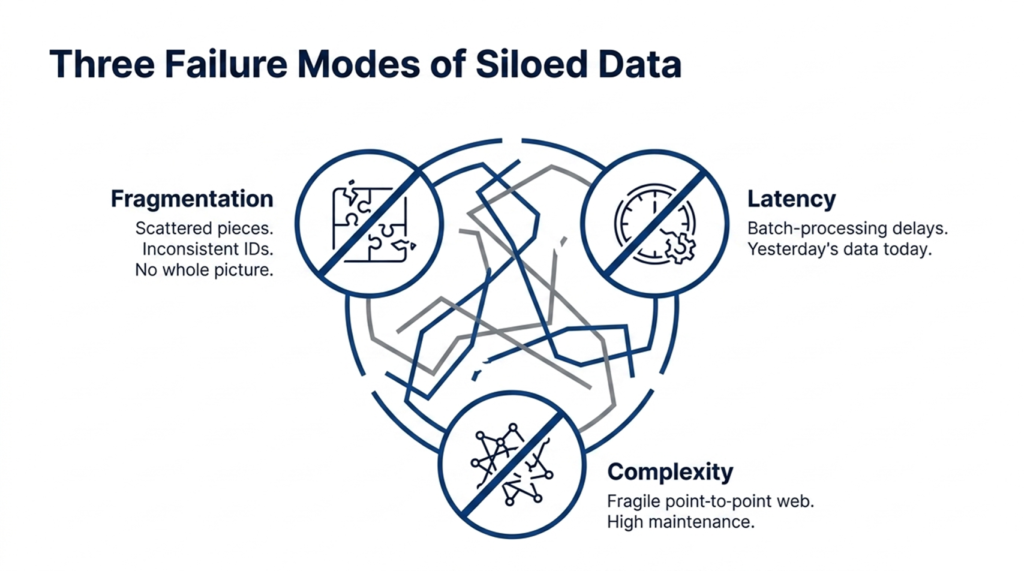
From an Enterprise Architecture perspective, the data silo problem has three distinct failure modes that compound each other.
The first is fragmentation. Customer data exists in multiple systems — transaction history in the core ERP, contact and interaction records in the CRM, behavioral data in the analytics platform, loyalty data in a separate service. Each system holds a piece of the picture. No system holds the whole. And because each was built and governed independently, the same customer often appears differently in each — different IDs, different address formats, different timestamps for the same event. The data is not just scattered. It is inconsistent.
The second is latency. In most enterprise architectures, the data that does move between systems moves on a schedule — a nightly batch process that consolidates records, reconciles balances, and updates the downstream systems that depend on them. In a world where customer interactions happen in real time, a twelve-hour data lag means that the customer who purchased this morning is still showing as a prospect in the afternoon call center system. The organization has the information. It cannot use it when it matters.
The third is complexity. As organizations attempt to solve the first two problems by connecting systems directly — linking the CRM to the ERP, the analytics platform to both, the loyalty service to all three — they create a web of point-to-point integrations that becomes progressively harder to maintain and increasingly fragile. Each connection is a dependency. Each dependency is a potential failure point. When one system changes, every integration that touches it must be assessed and often updated. The architecture designed to solve the silo problem becomes a silo problem of its own.
WHAT IS A DATA SILO — AND WHY IS IT A STRATEGIC RISK?
A data silo exists when information that should be shared across an organization is instead isolated within a specific system, team, or function — accessible to those directly using that system but unavailable, or available only with significant delay, to everyone else.Data silos form naturally. Systems are built to serve specific functions and are optimized for those functions. The CRM is optimized for managing customer relationships. The ERP is optimized for financial transactions. Each does its job well. The problem emerges when the business needs a view that crosses the boundaries of what any single system was designed to provide.
The strategic risk of data silos is not technical. It is competitive. Organizations that can act on a complete, real-time picture of their customers can personalize interactions, anticipate needs, and respond to problems before they escalate. Organizations operating on fragmented, delayed data are making decisions on an incomplete — and often incorrect — picture of their own business.
In a market where customer experience is a primary competitive differentiator, the organization with better data visibility wins. Not always. But consistently.
THE ARCHITECTURAL SHIFT: FROM STORING DATA TO MANAGING ITS FLOW
The conventional response to data silos is a data warehouse — a central repository that consolidates records from all source systems on a regular schedule. This solves the fragmentation problem partially. It does not solve the latency problem. And it does not solve the complexity problem — because the warehouse still requires integrations to every source system, each of which must be maintained as those systems evolve.
Strategic Enterprise Architecture approaches this differently. Rather than asking how to store data from multiple systems in one place, it asks how to make data flow from its point of origin to its point of use, in real time, without disrupting the systems that produce it.
This is not a subtle distinction. It is a fundamental change in how the architecture is designed, governed, and measured.
A data warehouse is a destination. Data flows into it on a schedule, and other systems pull from it when they need it. The architecture is built around the store.
A data flow architecture is a nervous system. Every significant event — a transaction, a status change, a customer interaction — moves immediately to wherever it is needed. The architecture is built around the movement.
The Customer 360 use case — giving front-line employees a complete, real-time view of every customer they interact with — is not solvable with a warehouse architecture. By the time the data has moved through the batch cycle, the interaction is over. The architecture must be redesigned around the flow.
THE QUESTION THAT COMES BEFORE THE ARCHITECTURE
In every modernization program, there is a temptation to begin with the technology selection — which platform, which pattern, which vendor. The Fit-for-Purpose discipline inverts this sequence.
Before any architectural decision was made in this engagement, the work began with a structured conversation with the people who would actually use the outcome.
The question posed to business users was direct: what information, if you had it in front of you right now, would change how you serve this customer or close this sale? Not what data exists. Not what the system can provide. What would actually make a difference in the moment it matters.
The question posed to data owners was equally direct: what are the constraints and semantics of the data you manage? What does it mean when a record shows a certain status? What context is required to interpret it correctly?
And the validation question — the one that determines whether the architecture is actually fit for its purpose — was posed to the front-line employees who would use the system: if this information reached your screen within two seconds of the event that created it, would it genuinely change how you work?
That last question is the one most architecture programs never ask. The answer to it is what determined the shape of everything that followed — the patterns selected, the integration approach taken, the governance model established. Not the technology. The concern.
The technology choices that resolved those concerns are the subject of Part 2 of this series.
Next in this series — Part 2: Stop Asking. Start Listening. How Event-Driven Architecture and CQRS work together to deliver real-time customer intelligence — and why each was the right choice for this specific problem.